Reviewed product and indication
Use current labeling and licensed professional guidance. Approval is product- and indication-specific.

Clear status labels. Primary sources. Practical explanations of evidence, quality claims, approval, and uncertainty—without generic dosing protocols or sales hype.
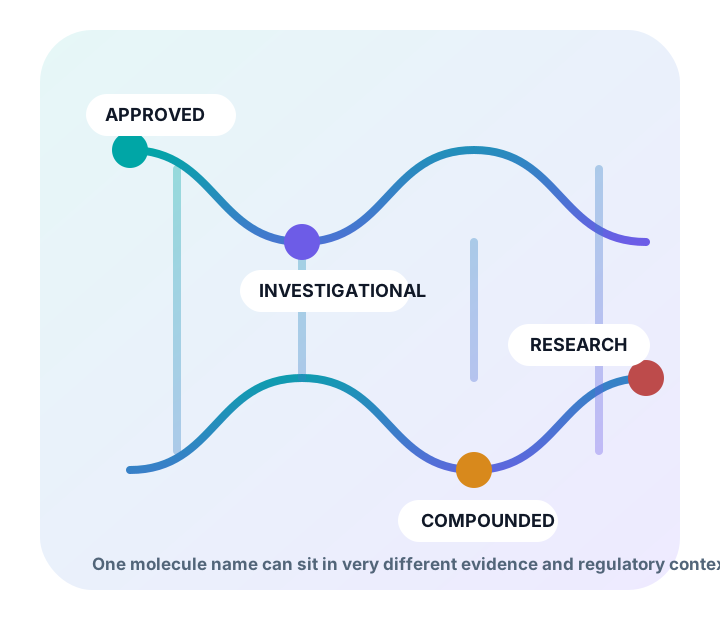
The same ingredient name can appear in four very different contexts. Start by identifying the category.
Use current labeling and licensed professional guidance. Approval is product- and indication-specific.
May be prepared under limited legal pathways, but it is not reviewed like an approved drug or generic.
A trial result is not a product approval or a personal-use protocol.
A disclaimer does not establish sterility, identity, potency, safety, or suitability for human use.
HowToUsePeptides.net is the authority site. It does not sell products or process transactions. Future links may point to a separate seller, but commercial relationships will never erase approval status, evidence limits, or visible disclosures.
Ipamorelin status, growth-hormone secretagogue claims, FDA concerns, stacking uncertainty, and limitations of online protocols.
View evidence profile →How topical cosmetic discussion differs from injectable use, plus FDA safety concerns, evidence limits, and product-quality questions.
View evidence profile →Regulatory status, evidence limitations, identity confusion, quality questions, and safety uncertainty surrounding TB-500.
View evidence profile →BPC-157 evidence, regulatory status, human-data limitations, safety questions, and the difference between research interest and established treatment.
View evidence profile →Current investigational status, trial context, online-product risks, and why retatrutide sold by research vendors is not clinical-trial material.
View evidence profile →What tesamorelin is approved for, what the label does not establish, formulation differences, and why broad weight-loss claims need scrutiny.
View evidence profile →Learn the difference between identity, chromatographic purity, assay, sterility, endotoxin, fill weight, and batch traceability.
A reader-focused checklist for spotting missing disclosures, unsupported claims, and potentially dangerous instruction content.
Read guide →Why an approved active ingredient does not make every compounded vial, salt form, or research product FDA-approved.
Read guide →What phase 1, 2, 3, and post-approval studies can\u2014and cannot\u2014tell you about a peptide candidate.
Read guide →